Showing posts with label Monetary Policy. Show all posts

Wednesday, September 24, 2014

Following the Lead on Interest Rates Isn’t a Strategy

Building a portfolio based solely on market consensus or projections isn't a strategy – it’s hope based investing.

Interest rates going up has been the consensus view since 2009.  Eventually this view will be right, so far it really hasn’t.  When exactly they go up I am unsure of, though I tend to think later than most. 

One thing I will not due is blindly follow market projections or consensus calls, which appear to be nothing more than throwing darts.  While the recent Fed statement contains “considerable time” before an interest rate increase, futures markets are assuming this will happen mid 2015:
Note:  This chart isn’t easy to read.  The blue line shows the actual Fed Funds rate, which is effectively 0 and has been since mid-2009.  The orange line shows what the futures market is predicting the rate will be in the future at the start of the line (e.g. when rates reached 0 in mid-2009 futures markets expected rates to rise back up quickly and be at 2.50% or so by mid-2010).  Lastly, the green line shows where we currently are that rates are projected to rise in mid-2015 and be at almost 3% by 2017.  Also, this chart was printed before the latest Fed Statement and thus futures markets may have adjusted.

What we can observe in the above charts is that market participants always expected the next rate rise to come and it never did.  Now markets did get better, projecting the rate rise out further and further, but none the less were still off. 

Will it be mid-2015?  Not sure, but even some widely used Fed models project the rate increase will be further out:

What about consensus analyst?  Not much better:
Source:  DoubleLine Funds


As you can see the black line where analysts expect the 10 year to be at year-end.  It has consistently moved down all year, along with interest rates.  Again, analysts have missed the calls on interest and this has been a reoccurring theme since 2009.

I am not advocating totally ignoring projections (though not a terrible idea I must admit and certainly better than the other extreme – following them religiously), nor am I advocating making your own market calls. 

But building a portfolio based solely on market consensus or projections isn’t a strategy – it’s hope based investing.  Instead, 1) make probabilistic assessments 2) have a plan if/when those move against you.

*Please see the important disclosures that apply to this commentary HERE.  The above charts are for illustrative purposes only and do not attempt to predict actual results of any particular investment.


Tuesday, November 5, 2013

30 Minutes to Understand the US Economy


I cheated this week and am making one longer commentary, as opposed to two shorter ones.  This is due to my own personal time crunch, and the depth required for this subject.

Further, I am using Google Docs. for the deeper dive into this piece, and can be accessed here.    What is contained there is my summary notes of the 30 minute embedded video Ray Dalio put together entitled “How the Economic Machine Works”. 

Dalio runs the world’s largest hedge fund, the $120B Bridgewater Associates. This is the most simple and succinct explanation of how money and credit are used in transactions, the sum of which is our economy: why we have booms and busts, where we are at in the current cycle, what’s likely to happen moving forward, etc.  Dalio boils this all down to the most basic fundamentals, and makes everything easy to understand.


While I don’t believe these views are mainstream economic thought, they are much in line with my beliefs on how the economy works, and provides a practical means to explain what has happened in the past.  Those who follow a similar viewpoint have been right more often than their peers.  So click the link, use my outline to follow along, and in 30 minutes, you will better understand what makes our economy tick and destroy those who challenge you at cocktail parties.

The views and opinions expressed herein are those of the author(s) noted and may or may not represent the views of Capital Analysts, Inc. or Lincoln Investment.  The material presented is provided for informational purposes only. Nothing contained herein should be construed as a recommendation to buy or sell any securities. As with all investments, past performance is no guarantee of future results. No person or system can predict the market. All investments are subject to risk, including the risk of principal loss.

Tuesday, July 16, 2013

The Freak Out

Mitzi, my mom’s dog, doesn’t get on the couch except when there is a thunder.  One clap of thunder and Mitzi jumps right up for the comfort of my mom.  As soon as the thunder subsides, Mitzi goes right back to sleeping on the floor. Not unlike Mitzi the dog, the markets get spooked when the equivalent of thunder causes alarm.


Another sell-off happened on July 10th as well:  after the minutes release the S&P 500 shot up and then sold off roughly 0.60%.  Where are we since the last Fed sell offs?


Despite the initial reaction, the S&P 500 is up since each of those Fed Minute release parties. 
Like most of the items in my commentary, I use this as an example – an extreme, short one at that.  It doesn’t tell you to invest or not to invest in stocks; however, it does show that markets can move quickly without fully digesting what is presented.

At times this can be a signal (times are changing) and at times it can be noise (a blip, but the trend doesn’t change).  The key is to try and distinguish between the two, but that can be difficult.  Thus, the most important takeaway is not let emotions dictate your investment decisions, which can lead to buying at the top and selling at the bottom. 

Having a plan in place and executing that plan is the best way to keep yourself in check, minimize risks, and subsequently gain long-term returns.   

Past performance is no guarantee of future results.  Diversification does not guarantee a profit or protect against a loss. International investing involves special risks, including, but not limited to, the possibility of substantial volatility due to currency fluctuation and political uncertainties. The views and opinions expressed herein are those of the author(s) noted and may or may not represent the views of Capital Analysts, Inc. or Lincoln Investment.  Nothing in the above writing should be taken as an investment recommendation. 


Tuesday, June 25, 2013

Making Sense of Recent Market Moves


The last week or so has certainly caused some anxiety among equity and fixed income investors.  I decided Sunday and Monday to look more in depth and draw some conclusions.  

What follows is my analysis, which I sent out to our firm; however, does NOT include the corresponding research behind it or the awesome, pretty charts.  I should note that without the research in which to refer, the bullet points may be a bit hard to digest.  In those instances, if anyone wishes further details please email me (zabrams@capitaladvisorsltd.com).


As I write this, prices have seen some reversal, which in some ways encapsulates what I am trying to illustrate below.  The key, whether or not I am right or whether I am wrong, is to focus on the intermediate-term window, try and funnel out what is happening in these violent short-term moves, and don’t panic!!

  • The markets of late have been interesting as stocks and bonds have both seen downward market volatility.  This makes asset allocation a nasty task
  • Starting in 2009, rising yields have been bullish for stocks.  Falling yields have been bearish until they hit their floor.  However, the general low level of interest rates has been bullish for stocks (lower interest rates = lower discount rate = higher valuations AND lower interest rates = lower cost of borrowing = higher EPS).  Thus, it seems logical that the higher yields, higher stock prices makes sense for the time being as the move in interest rates has been large and could be construed as a secular change   
  • When put in perspective neither stocks or equities looks as bad, but should continue to be watched.  Further, a 3% to 4% loss in bond portfolios is hardly reason for panic
  • Bonds in particular appear due for at the very least a short-term bounce
  • Stocks could have more to go, but should have a floor as:
    • Lower prices increase likelihood of Fed loosing
    • Economic data is too good for stocks to ignore
  • It’s likely that either bond yields settle OR move down given at some point the rising yields will probably hurt the economy and loosen Fed policy
  • Even If they don’t (e.g. the economy gains in strength) then properly allocated fixed income portfolios should be  hedged as:
    • Stocks should perform well
    • Active fixed income management should outperform passive
    • Duration should be relatively low
  • As it relates to portfolio management the above points to:
    • Letting this FMOC re-calibration shakeout and remaining calm
    • If there is a need to pull the trigger, a small move to cash is probably the best place to go instead of a secular change in the portfolio (e.g. selling a portion of intermediate-term bonds and moving to cash > selling all intermediate-term bonds and moving to short-term bonds)
      • Even if this is the start of a secular move in interest rates, the odds are likely there will be a short-term reversal
    • Use the market trends as a guide and not a road map to violent short-term moves
    • At some point soon, diversification will work again in terms of moderating (though not completely containing) risk 
    • I still think the highest probability path is this: rapid rise in interest rates hurts economy > equities struggle > yields lower in anticipation of Fed loosening (maybe not QE though) + safety > stocks fall until easing back on > yields range bound.
      • Note: an alternative would be if interest rates continue to rise as growth improves, which again is bullish for equities.  Not so much for bonds

Past performance is no guarantee of future results.  Diversification does not guarantee a profit or protect against a loss. International investing involves special risks, including, but not limited to, the possibility of substantial volatility due to currency fluctuation and political uncertainties. The views and opinions expressed herein are those of the author(s) noted and may or may not represent the views of Capital Analysts, Inc. or Lincoln Investment.  Nothing in the above writing should be taken as an investment recommendation. 

Tuesday, June 11, 2013

Macro Musings via El-Erian

Josh Brown recently wrote a blog post highlighting what Mohamed El-Erian said at the PIMCO Investment Conference.   Since my invitation got lost in the mail, I had to settle for reading his summary, which was quite good. 

Like Mr. Brown, I think that Mohamed El-Erian is not only a great macro thinker, but communicates his/PIMCO’s views as clear as anyone.  Further, their track record has been extremely solid since before the financial crisis despite the occasional misstep.   I doubt you could find much better.


Three things really struck me.  For ease, the big bullets are Josh’s notes along with El-Erian’s quotes.  The highlights are mine to add emphasis.  My comments are in italics under their respective bullets.
  1. Risk management: People used to think that diversification was good enough, but no more. "Diversification is necessary for any investor but it is not sufficient when central banks have distorted prices."  He says the way to think about insuring tail risk is the same as you would car insurance. You maintain it at all times, not try to guess when you'll need it. He is talking about far-out-of-the-money options that hedge against unforeseeable outlier events, which is what his fund does.
    • I totally agree that diversification is no longer adequate to control risk, given how correlations move to 1 and -1 in times of stress.  Tail risk insurance, using momentum to move risk on/off, and/or stop-losses at waterlines are good ways to contain risk.  Diversification only manages to moderate risk.  That is an important distinction.
  2. Beta heavy lifting:  He thinks the beta heavy lifting is probably over in asset markets. In bonds, he says the capital appreciation returns from treasuries, corporates and high yield bonds are done too.  Lastly, someone asked him a Vanguard-related passive indexing question. Mohammed tells a killer anecdote from early in his career about how EM bond indexes were once made up of 22% Argentinian bonds pre-default, and that the other managers who were hugging that index got hammered. He says that passive makes sense only if you'll be driving in reverse up a road that is completely straight. Because you're essentially looking at snapshot of the way things were.
    • Passive is less preferable to active in this environment.  Again, I think he is spot on here, though PIMCO would have this view given they are an active shop.  This is especially true on the Fixed Income side.  I will say the caveat is finding the right active managers, which is more of a qualitative function and can prove to be difficult.
  3. Central Bank Brand Management:  He says basically a brand is like a wedge you can shove in between fundamentals of your company or product and raise prices. But that brand wedge is finite and cannot keep things apart or elevated indefinitely, there is a limit to what a brand can doCentral banks are also a brand. The brand is "we can deliver outcomes today to improve the future."  Right now people believe in the central bank brand, watch out for when that belief in the brand turns. Right now the psychology about the Fed's brand is positive, "but psychology goes both ways."
    • What if Central Bank psychology in regard to the market reverses?  Admittedly this is something I need to look into more.  He elaborated more on that thought recently.  His basic point is that even powerful brands can only continue for so long until fundamentals justify (or on the negative side, no longer justify) the price (e.g. he mentions APPL).  In this specific instance, it’s that central bankers are hoping that in increase in financial market prices will filter down to the real economy.  El-Erian is skeptical this will work, and notes risks about the unintended consequences. He wonders what happens if investors no longer believe the fundamentals justify the financial market prices, even if central bankers continue their current policies.  All of these are legit concerns; however, in my opinion they are all fixable.
Past performance is no guarantee of future results.  Diversification does not guarantee a profit or protect against a loss. International investing involves special risks, including, but not limited to, the possibility of substantial volatility due to currency fluctuation and political uncertainties. The views and opinions expressed herein are those of the author(s) noted and may or may not represent the views of Capital Analysts, Inc. or Lincoln Investment.  

Friday, June 7, 2013

QE Taper or Not… and What Happens if it Does Occur?

When will the Fed taper its purchases of Treasuries and mortgage backed securities as part of its Quantitative Easing?  That seems to be the biggest discussion going on at all the hottest clubs.  The chief economist from my favorite econ research team (Goldman) said “A September tapering is certainly possible”.


In an economic sense, QE is more debated than JB at the Heat Game 7.  Regardless of whether QE works, is destructive long-term, neither, or both, I want to focus on its impact on equity markets where I see 3 common reasons why it’s bullish:
  1. Higher earnings of companies through refinancing as interest rates are pushed down.
  2. Low bond yields force investors into higher yielding assets (e.g. stocks), which in turn forces up stock prices and valuations.
  3. QE creates liquidity (e.g. I hold a bond, the Fed buys it, I now have cash), which has to be put somewhere.  One of those places is the equity market.

Ipso facto, QE tapering would be bearish for equities.  I do believe that is a risk, but at least for now under the current facts and circumstances – facts and circumstances which can and do change – I am less concerned, and here is why:
  1. Econ Data Still Not There:  from the same article “I think that is going to depend on the data… Chairman Ben S. Bernanke expresses caution over trimming the program too soon… The likelihood that the economy will continue to grow about 2 percent over the next couple of quarters with inflation ‘well below’ target will probably stay the Fed’s hand until December”.
  2. Closer to End of Recovery Cycle: Cullen Roche at Pragmatic Capitalist elaborates on the last bullet: we’re in the backstretch of the recovery, unemployment is still way too high, corporate revenues are starting to falter.
  3. Tapering Not Huge Anyway: if they do taper, consensus isn’t exactly a large change to the Fed’s balance sheet.
  4. Good Economic News Drives This Decision: as insinuated earlier, if the Fed is tapering then economic data is good.  If economic data is good, then stocks should do well.   

That last bullet is the key.  If economic data falters as the Fed tapers their purchases then equity markets will be in trouble.  A good article at Learning Bonds points out that fact QE and equity prices is even a conversation points to artificially inflated equity values.  Thus, if data comes in weak stocks would be more likely to revert to their fundamental value. 

Past performance is no guarantee of future results.  Diversification does not guarantee a profit or protect against a loss. International investing involves special risks, including, but not limited to, the possibility of substantial volatility due to currency fluctuation and political uncertainties. The views and opinions expressed herein are those of the author(s) noted and may or may not represent the views of Capital Analysts, Inc. or Lincoln Investment.  

Thursday, May 30, 2013

Bonds Aren’t as Stupid as Their Yields Indicate

Buying and holding bonds in the current environment might make you ill.  If you hold a Treasury Bond for 10 years you receive roughly 2% on that money annually for the next 10 years.   That’s in nominal terms too.  If inflation averages a little more than 2% that you essentially get 0%.  Higher quality corporate bonds aren’t much better.

Note: Left graph is based on 10-year Treasury bond coupled with inflation expectations.  Right graph is AA Corporate effective yields.

To summarize the graphs – buying and holding a Treasury or high quality corporate bond for 10 years is the investing version of Chinese water torture.   So why invest in bonds at all?
  • They still will likely provide the best hedge against a declining equity market.  From November 07 to March 09 S&P 500 declined 44% with the Aggregate Bond Index was up 7%.
  • Smart money is on Fed staying loose and keeping interest rates low for some time.  Even if they taper bond purchases later this year or early next year.
  • Demographics and risk aversion provide a market for higher quality bonds. 
  • Yields can stay low for a long time.  Ask Japan.
  • Since 1976 the Aggregate Bond Index max loss over a 12 month period has been 9%.  Not what I would call a catastrophic loss so your principal probably won’t be decimated. 
  • The world bond market is $90 trillion (compared to equity market size of $40 trillion), so there are a lot of places to seek out return (i.e. there are more than just Treasuries and Corporates out there).
  • There isn’t a bubble, at least anecdotally.  How many investors you know brag about their bond portfolio over the past few years and compare that to their real estate portfolio in 2007 or their tech stock portfolio in 1999.
  • Check this out:
That shows the 10 Year bond going from 2% to about 1.60% in a little less than 2 months.  It also shows the long bond ETF going up in value.  Point being, bond trades can capitalize on these quick moves in yield.
I take all of the above and come up with the following bond investment cocktail.
  1. While the risk of buying and holding is probably low, the upside is muted when it comes to quality bonds.
  2. Still given the depth of the bond market and short-term moves in yields, returns can be had.
  3. Thus, move away from more passive buy and hold bond investing to quality managers who have the leeway and skill to navigate the fixed income space.

Past performance is no guarantee of future results.  Diversification does not guarantee a profit or protect against a loss. International investing involves special risks, including, but not limited to, the possibility of substantial volatility due to currency fluctuation and political uncertainties. The views and opinions expressed herein are those of the author(s) noted and may or may not represent the views of Capital Analysts, Inc. or Lincoln Investment.  

Thursday, May 16, 2013

Low 10-Year Return Projections <> Underweight Equities


The stock market looks expensive when you take an intermediate term view (3 to 10 years).  That sounds a tad frightening, but don’t let the long view lead to short-sighted decisions in your equity portfolio - at least for the next 12 to 36 months.

A recent MarketWatch article, by Mark Hulbert points to indications of long-term overvaluation and asserts the following:
  1. Stock market is not at all-time high in real terms and is 24% below the peak.
  2. CAPE (i.e. long-term Price to Earnings, a longer-term valuation metric) suggests weak market returns over the next 10 years (close to zero in real terms).
  3. Despite CAPE being rich, it doesn’t mean markets will move in a straight line down and the recent rally (I assume since the 2009 bottom) can continue.
I believe we run similar in-house models to Mr. Hulbert, and while I tend to agree, they do need some context:
  1. This suggests the market still has more room to run.
  2. Other valuation models we run indicate a similar trend.  But over time market valuations have trended up, suggesting the decline may not be as severe as the average would dictate.
  3. The market can stay overvalued for quite some time and the conditions appear to be in place them to do so.  I actually just heard famed investor Joel Greenblatt mention the market is cheap on his free cash flow measure, a shorter-term metric, and this is confirmed amongst sell side research we use.  Also, momentum metrics can help determine when a change in the market is afoot.
So I am on board with the contention the market will revert to the mean as this market cycle ends, leading to a correction, which very well could be larger than anticipated by most.  But I also think there needs to be some perspective around it – don’t miss the upside while you wait for the mean reversion.

The takeaway is to make sure you and your advisor are aware of the longer-term trends and the likelihood of mean reversion, but don’t avoid stocks altogether.  Just have a plan to mitigate the risk when the upside trend starts to reverse. 


Past performance is no guarantee of future results.  The views and opinions expressed herein are those of the author(s) noted and may or may not represent the views of Capital Analysts, Inc. or Lincoln Investment.  


Friday, October 5, 2012

OMT. Part III


Outright Monetary Transactions (OMTs) were announced on September 6th, so what is the plan:
  1. ECB buying bonds up to a maturity of 1 to 3 years on the secondary market with new Euros
  2. Purchases will only occur in countries who request help from the EFSF/ESFSM (and subsequent ESM) bailout funds, which purchase debt on the primary market)
  3. Purchases are conditional on reform programme
  4. Purchases stop if country no longer needs help or if don’t comply with the agreed to conditions
  5. No exact amount of purchases will be outlined and determined by ECB governing council
  6. Purchases will be sterilized fully (e.g. buy Spanish bonds with ECB reserves and then sell German bonds, making reserves in system neutral and lowering inflation risk), TBD
  7. No yield caps
  8. Not senior to other bond holders
Here is what I think the result will be.  This is what I sent internally relatively verbatim on September 6th, after the announcement:

The plan goal is to save the Euro - preventing runs on countries that investors feel may leave.  In other words, capital flows out of Spanish banks because as yields on Spanish debt rise, which is a result of banks not bidding on Spain's debt due to default concerns, depositors are nervous they will get a devalued Peseta (i.e. the new Spanish currency). 
As of now, the market is on board as yields in the periphery sank.  In fact, Spain's 10-year was under 6 for the first time since May.  It should be noted though that this happened the last two times the ECB announced a bond buying program only for yields to shoot higher.  However, longer-term is another issue. 

The two keys are "unlimited" and "conditions".  The first would appear to be a bazooka, if investors believe the quantity is unlimited then default is off the table and there would be no reason for capital to flee banks.  I think this would hold true, even if you buy longer dated bonds (5 year bonds eventually have a maturity less than 3 years).  Still, conditionality will ultimately decide this thing. 
For instance, say Spain requests EFSF and subsequently is involved OMT on the condition they keep their deficit at 3% GDP and insist on spending cuts.  Such austerity could actually cause the deficit to rise and/or could be politically unpopular as the economy shrinks further.  At which point, Spain can't keep up the conditions, then what?  Maybe it doesn't matter, as Spain will then have leverage - destroying the Euro and hurting the ECB balance sheet (now full of Spanish bonds).  But if it does and the ECB stops the funding once the conditions aren't met, then it could mean the end of the Euro. 

In short, a Euro breakup is off the table (maybe sans Greece) for now, but it’s much of the same – kicking the can down the road.  At least IMO; however, the plan does seem to have more firepower.


Tuesday, October 2, 2012

OMT. Part II


In my last post I outlined why I think interest rates were rising, absent from that was a discussion on what monetary policy can do to prevent bank runs, help the economy, and assist in keeping public interest rates low:
  1. As defaults happen, central banks can lower interest rates (increasing liquidity, interbank lending, etc), engage in asset purchases (e.g. quantitative easing), act as the lender of last resort, etc.  All of these tools help prevent runs on the bank. 
  2. Further, expansionary central bank tools should in theory should encourage banks to lend, stimulating the economy.  It also lowers the value of the currency and creates inflation.  The former helps exports and competitiveness, while the latter helps inflate away debt (as opposed to default).
  3. A central bank can create money out of thin air.  It can also require banks to bid on Treasury auctions (as in the US).  As a result the central bank can set interest rates on public debt if need be.
The problem in the EU is that each country is not in control of its own currency, they are subject to the ECB.  Thus, while the US can do all the above, Spain for instance is beholden to the ECB.  This is why I believe their interest rates on public debt were rising…

There was no guarantee the ECB will create the reserves if need be to purchase public debt (e.g. the ECB will purchase or will have banks purchase public debt), as a result the government is revenue constrained to what it can procure in tax revenue and what it can finance in the market.  As tax revenues fall, the likelihood of default increases, which in turn causes the market to push up interest rates, and again increases the likelihood of default, so goes the circle…

Again, the contrast here is that the market realizes the Fed can dare it to sell the Treasury bonds.  The Fed has endless reserves to do so in order to keep interest rates where they want to (see QE3).  The countries in the EU can’t create their own reserves and thus are dependent on the ECB to do so.


Thursday, September 27, 2012

OMT. Part I


These blog posts eventually lead to the Outright Monetary Transactions (OMTs), which was recently announced by the ECB.

First, I think it’s important to get a refresher on the problems in Europe.  I am going to use Spain as an example. 
  1. Countries like Spain ran up large debts earlier in the decade, which was a boom to asset prices and growth. 
  2. Thus, as capital began to leave Spain asset prices began to fall.  And so started a negative feedback loop – lower asset prices, capital flees, resulting in lower asset prices, more capital flight, etc.
  3. This puts Spanish banks in a bad spot as their assets decrease in value and their funding sources dry up.  This results in a pullback in lending.
  4. So back to point 1, growth was also dependent on credit, which is now being taken away.  As a result, growth stalls.  Again this creates another negative feedback loop – lower growth, less lending, resulting in lower growth, thus less lending, etc.
  5. The combination of 2 and 4 lead to private defaults and exacerbates the fall in asset prices and growth.  Further, it puts the banks at risk.
  6. This also leads to a collapse in tax revenues, a massive increase in stabilizers (i.e. the social safety net), a possible bailout of the financial system, and thus a ballooning of the public deficit to GDP.  This in turn causes interest rates to rise.
  7. Rising interest rates create a self-fulfilling prophecy.  Higher interest payments = higher deficit = higher interest rates.  This continues until a breaking point when interest rates are too high and governments default.  
  8. Simultaneous to #1, foreign capital is being pulled out of banks (i.e. “a run on the bank”) as the probability of public default rises.  This is because after the default deposits will be in the new local currency, which will be devalued relative to the Euro.
  9. Number 8 exacerbates the problem of interest rates rising, as the reserves used to pay off public debt being to dwindle.
If you read the above and thought “this sounds a lot like the US” you would be correct… up until number 6.  So why aren’t we seeing the same sort of interest rate problem as Spain?  The most basic reason is that a key ingredient in the above is missing – monetary policy (the Fed and ECB).  


Monday, September 24, 2012

In Retrospect, What Did QE1 and QE2 Bring?


Again, I hope to get to some economic charts shortly, but for now let’s focus on asset prices.  The Big Picture posted some great charts on the previous QEs and Operation Twist (OT) and how various asset classes reacted.  Since I am not sure if I can post them (please check out the link), here is summary:
  • Yields.  It’s interesting that yields rise after QEs.  They do drop drastically before QEs though.  Markets are basically buying the rumor and selling the news.  The same could be said about OT, while yields have gone lower it wasn’t until earlier this year.  I don’t think it was coincidence QE3 rumors started then.  I can’t see a divergence between the 10 and 30 year.
  • Stocks.  Equity prices did rise rather nicely.  However, it does appear that there is a near-term pullback in prices at first.    Again, it appears investors start buying QE before it even happens.
  • Commodities.  Prices rise pretty much throughout QE and on the rumor.  Like equities, there appears to be a selloff at the launch before a nice move higher.  
Also, from those charts I took a look at some numbers and came up with the following chart:


One thing that jumped out was that stocks and oil didn’t have as big a jump after QE2 as they did in Q1.  This would be concerning now given that the QE3 has already seen about the same rise.  Still, the highs and lows are relatively subjective.  Further, maybe the open-ended nature or current economic conditions would generate higher returns than QE2.

Gold and commodities appear to have the most upside, as rose by close to the same amount both QEs and have barely got off the ground this round.


Wednesday, September 19, 2012

QE3 – A Quick Thought


On September 13th the Fed statement was extremely accommodative.  Here are some highlights:
  1. Extending language "exceptionally low … federal funds rate are likely to be warranted at least through mid-2015"
  2. New round of QE to MBS (not Treasuries) & rolling maturing MBS from previous asset purchases "purchasing additional agency mortgage-backed securities at a pace of $40 billion per month... maintaining its existing policy of reinvesting principal payments from its holdings of agency debt and agency mortgage-backed securities in agency mortgage-backed securities... increase the Committee’s holdings of longer-term securities by about $85 billion each month through the end of the year"
  3. Extending operation twist "continue through the end of the year its program to extend the average maturity of its holdings of securities as announced in June"
  4. Asset purchases appear open-ended (as opposed to a set $ amount) "outlook for the labor market does not improve substantially, the Committee will continue its purchases of agency mortgage-backed securities, undertake additional asset purchases, and employ its other policy tools as appropriate until such improvement is achieved in a context of price stability". 
  5. Fed officials also upgraded their economic forecasts significantly.
So that was the announcement.  The takeaways?
  • There also isn't a consensus this is actually economically stimulative.  I myself wonder how will lowering already low mortgage rates will help stimulate demand?  I will post on this shortly after I look into some data.
  • Even if it doesn’t help the economy, does that mean QE is meaningless?  No.  If it follows the past QEs stocks and commodities should have a nice go of it.
  • So if we assume it doesn’t help the economy, how can it help stocks?  Multiple expansion. 
  • One measure of stock value is Price/Earnings.  So if Price is $100 and Earnings are $10 then P/E = 10.  If we assume QE doesn’t affect the economy then earnings stay at $10, but QE does help a stock’s P goes to $110.  The P/E is now 11, however fundamentals remain unchanged.  
  • The open ended comment essentially assures Treasury yields shouldn't have a large move up and volatility in that market should be muted.
  • Treasury and agency spreads should narrow further.
  • The Fed won't be tightening until there is a dramatic change in the economic data.  
  • Is the Fed now out of bullets?
In my next post, I want to touch on what happened to various asset prices the last two times we have QE.


Friday, August 26, 2011

Revisiting Quantitative Easing


Much of the sell-side research we get is hinting that more quantitative easing in on the way.  Here is a Bloomberg article that highlights this.  This would be QE3.

In the past I have highlighted that QE didn’t appear to accomplish much in the real economy (as opposed to the financial markets).  Further, the Pragmatic Capitalist has an extensive list with graphs on how QE2 turned out.  Here are the highlights:
  • Private sector lending did not increase
  • Unemployment was not reduced
  • Consumption didn’t increase
  • GDP didn’t pickup
  • The dollar moved down and exports moved up.
  • In the meantime, it appears the initial positive effect on equity markets has evaporated as the S&P 500 is close to the value it was when QE2 was announced.  
  • Many commodity prices have also pulled back, although are still higher than they were last August. 
  • Interestingly, Treasury yields rose as the Fed purchased longer-dated Treasuries and fell when the purchases stopped. 


Thus, I still don’t think more QE is the answer and my points are the same as they have been all along:
  1. QE2 doesn’t appear to have a substantial impact on the real economy with the exception of commodity prices and exports.
  2. The resulting increase in commodity prices actually hurts the consumer.
  3. There was an increase in exports, which helps growth; however, given the lack of pickup in GDP this was negated by other factors.
  4. It does seem to impact equity and commodity markets; however, that appears to be temporary. 
  5. The Treasury market didn't seem to move at all.


Friday, August 12, 2011

1937, or Why I Want More Short-Term Spending


I have mentioned on many occasions that I think the Federal Government should increase stimulus spending in the short-term.

And in my last post I outlined how the Feds tightened monetary policy and decreased spending in 1936 and 1937.  So here are a couple consequences. 

  • GDP sank:

With a quick glance at my previous post, you can see when spending picked up both GDP and unemployment started to look better.  The money supply also increased again.  

Now is it possible the monetary and fiscal contraction were not the cause of the 1938 recession?  Or that maybe only monetary or fiscal policy matters?

Of course; however, given the past fallout from such contractionary policies I don’t believe it is prudent to do either at this moment.  This is especially true since inflation and interest rates are low.  As such, the risk/reward trade-off of cutting back seems heavily skewed toward risk. 


Thursday, August 11, 2011

1937, a Primer


In the late 1920’s we had a massive credit bubble collapse, we then loosened the money supply and increased Federal spending to help improve the situation.   In the later part of this decade we had something similar. 

Here is what happened in 1937.

First, the Fed tightened monetary policy.  Starting in 1936 and through 1937 the Fed doubled reserve requirements (the amount of cash a bank must hold relative to its liabilities).  You can see how the money supply dropped here.

Less money = less lending = less borrowing = private sector contraction = recession. 

Now it is possible that if Federal government spends money it can counteract the drop in the private sector, along with an increase in exports (GDP = private consumption + private investment + government spending + net exports).

Did the Federal government spend in 1937?  Nope.  They also raised taxes.  


So to conclude, things were starting to look better later in the 1930’s; however, the Feds tightened monetary policy and decreased spending.  In my next post I will cover the fallout from that and why I think it’s dangerous to follow a similar path now.


Monday, July 25, 2011

Why the US Doesn’t Have the Same Issues as the Eurozone

As a follow up to my previous post on the Eurozone, I will now attempt to explain is why the US is different than the Eurozone.  Again, I am going to use a very basic example:
  1. Country US and Country Emerging have different currencies.
  2. Country US and Country Emerging borrow at different rates given that they have independent central banks and their currencies fluctuate freely in the market. 
  3. Country US borrows money from Country Emerging; however, it borrows in its own currency.  This makes Country US’s currency depreciate in value.
  4. Country Emerging wakes up one day and realizes this is lunacy and stops funding to Country US’s private sector.  This presents a problem, as Country US’s growth is dependent on this funding.
  5. Given Country US has a different currency than Country Emerging they print money and inflate/devalue their currency, increase competitiveness, and boost exports, which reduce the debt burden and help growth.
  6. To further ease the slowdown, Country US’s government spends money in order to keep growth from plummeting.  Given they print their own currency and have debt denominated in their own currency, they are not dependent on Country Emerging to fund their government.  Thus, they can continue to borrow.
  7. As a result, Country US has the ability to increase government spending, helping the economy grow or at least hamper the slowdown.

Wednesday, July 20, 2011

The Eurozone Problem – A Three Minute Lesson

This is an incredibly difficult topic to understand. Cullen Roche presents it succinctly here; however, for this post I am going to use a very basic example and really simplify this complicated issue down:

  1. Country ABC and Country XYZ have the same currency, but broadly speaking, Country XYZ is a more risky place to invest. 
  2. Given that they share the same currency and central bank, when things are good Country XYZ can borrow at the same low interest rate as Country ABC. 
  3. Because Country XYZ is more risky, the private sector takes on more debt (if you should be borrowing at 7% and you can borrow at 2%, you borrow more), which is often lent to them by Country ABC.
  4. Country ABC wakes up one day and realizes this is lunacy and stops funding to Country XYZ’s private sector.  This presents a problem as Country XYZ’s growth is dependent on this funding.
  5. Given Country XYZ shares the same currency as Country ABC they can’t inflate/devalue their currency, increase competitiveness, and boost exports, which would reduce the debt burden and help growth.
  6. As a result Country XYZ must have the government spend money in order to keep growth from plummeting.  However, given they don’t print their own currency they are dependent on Country ABC to fund their government.
  7. Country ABC won’t fund Country XYZ’s government given the massive drop off in growth and high debt burden.
  8. Country XYZ has to cut government spending, reducing growth further and creating a vicious cycle.
  9. Country XYZ may have to leave the currency, devalue, default, and suffer a lot of pain before ultimately recovering or…
  10. Continue to cut spending, stay in the currency, and have a drawn out stage of low/negative growth.

In my next post I will compare and contrast the Eurozone with the US.  Here’s a hint: while we have our own problems, at least we don’t have these.

Monday, July 18, 2011

Inflation? Not Sold Yet

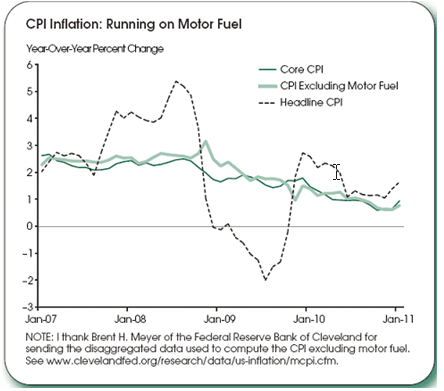
With gas prices high and food prices rising, many people are feeling the squeeze.  This begs the question: Is inflation a concern?  I say no, not yet at least, and the chart from the St. Louis Fed (via the Pragmatic Capitalist) illustrates why:


As the chart shows, essentially all prices outside gasoline are staying relatively flat.  While there has been a modest uptick as of late, as Paul Krugman points out, inflation is still way below trend. 

That isn’t to say inflation won’t eventually be a problem.  In fact, I have seen charts, given the recent move up, that demonstrate there could be higher inflation in the near future.  Still, given the small uptick in inflation, high unemployment, and lack of credit moving through the system, inflation should be relatively tame and I certainly assuage only a very small probability to hyperinflation.