Friday, July 29, 2011

The Debt Ceiling is Stupid

What is the debt ceiling?  It’s a relatively arbitrary limit set by Congress on how much debt the government can issue.  It’s a big deal now because the debt ceiling must be raised in order for the US government to meet its obligations and borrow more funds in the bond market.

If the debt ceiling isn’t raised, some or all of the following will happen:

  • Government employees stop getting paid
  • Government services are stopped
  • Projects go on hold
  • Interest payments aren’t made on current debt (US defaults)
The severity of each outcome remains to be seen.  The order in which this would occur is an uncertainty, with the exception of the interest payments on US issued debt. Despite what the press says, this will not lead to an immediate default on US debt, but debt payments would be made at the expense of the government salaries, services, and entitlements. At the very least our debt instruments would be downgraded by the rating agencies, because of the failure to pay and the uncertainty of payment.

Regardless I don’t think anyone could argue this would be a good thing given our current environment.  Any of these would further weaken the already weakening macro data (e.g. unemployment, manufacturing indexes, etc.) and certainly not be good for stocks. Of course if the interest payments aren’t made this could open up a whole new set of problems, mainly rising interest rates caused by a lack of confidence in the United States to pay their obligations.   The 30 day Treasury has long been used as a proxy for the risk-free rate of interest. 

Most commentators think this is going to happen and the market, while volatile, doesn’t appear to be signifying the debt ceiling won’t be raised.  That said, Congress seems to be full of idiots/ideologues so anything is possible and the longer it goes on the more uncertainty there will be in the market.

Wednesday, July 27, 2011

Trading or Investing?

Recently PIMCO disclosed their holdings, which indicated they increased their Treasury bond holdings.  This seems to be in direct conflict from months earlier when they reduced their Treasury bond holdings.  In fact, PIMCO chief Bill Gross’ public media statements resulted in a few clients calling wanting to blow out of Treasuries because PIMCO was.

A Portfolio Manager manages according to the requirements of their offering documents or prospectus.  They are able to buy and sell what they want when they feel it is best for the portfolio in accordance with those governing documents. 

What’s the point?  Just because an investment manager is screaming at the top of his or her lungs to enter or exit a position doesn’t mean you have to.  Many of these managers turn over their portfolio 2 or 3 times a year.   Thus, what they hate one month may be their biggest trade the next.  They are trading to profit from a spread. If you chase them, you risk being behind the curve, and may only wind up chasing your tail.

The key takeaway is this: if you are investing for the long haul you shouldn’t necessarily worry when a trader is getting in or getting out.  Just because a trader is exiting a position now doesn’t mean that position is a bad investment, it just means that trader thinks somewhere down the road there might be a better entry point.  Those investors who try to mimic traders seldom have the information necessary to make a good decision.

I suspect many investors who followed the tailwind of major portfolio managers and news reports will discover that they are not better off than those who followed their original investment discipline. 

Monday, July 25, 2011

Why the US Doesn’t Have the Same Issues as the Eurozone

As a follow up to my previous post on the Eurozone, I will now attempt to explain is why the US is different than the Eurozone.  Again, I am going to use a very basic example:
  1. Country US and Country Emerging have different currencies.
  2. Country US and Country Emerging borrow at different rates given that they have independent central banks and their currencies fluctuate freely in the market. 
  3. Country US borrows money from Country Emerging; however, it borrows in its own currency.  This makes Country US’s currency depreciate in value.
  4. Country Emerging wakes up one day and realizes this is lunacy and stops funding to Country US’s private sector.  This presents a problem, as Country US’s growth is dependent on this funding.
  5. Given Country US has a different currency than Country Emerging they print money and inflate/devalue their currency, increase competitiveness, and boost exports, which reduce the debt burden and help growth.
  6. To further ease the slowdown, Country US’s government spends money in order to keep growth from plummeting.  Given they print their own currency and have debt denominated in their own currency, they are not dependent on Country Emerging to fund their government.  Thus, they can continue to borrow.
  7. As a result, Country US has the ability to increase government spending, helping the economy grow or at least hamper the slowdown.

Wednesday, July 20, 2011

The Eurozone Problem – A Three Minute Lesson

This is an incredibly difficult topic to understand. Cullen Roche presents it succinctly here; however, for this post I am going to use a very basic example and really simplify this complicated issue down:

  1. Country ABC and Country XYZ have the same currency, but broadly speaking, Country XYZ is a more risky place to invest. 
  2. Given that they share the same currency and central bank, when things are good Country XYZ can borrow at the same low interest rate as Country ABC. 
  3. Because Country XYZ is more risky, the private sector takes on more debt (if you should be borrowing at 7% and you can borrow at 2%, you borrow more), which is often lent to them by Country ABC.
  4. Country ABC wakes up one day and realizes this is lunacy and stops funding to Country XYZ’s private sector.  This presents a problem as Country XYZ’s growth is dependent on this funding.
  5. Given Country XYZ shares the same currency as Country ABC they can’t inflate/devalue their currency, increase competitiveness, and boost exports, which would reduce the debt burden and help growth.
  6. As a result Country XYZ must have the government spend money in order to keep growth from plummeting.  However, given they don’t print their own currency they are dependent on Country ABC to fund their government.
  7. Country ABC won’t fund Country XYZ’s government given the massive drop off in growth and high debt burden.
  8. Country XYZ has to cut government spending, reducing growth further and creating a vicious cycle.
  9. Country XYZ may have to leave the currency, devalue, default, and suffer a lot of pain before ultimately recovering or…
  10. Continue to cut spending, stay in the currency, and have a drawn out stage of low/negative growth.

In my next post I will compare and contrast the Eurozone with the US.  Here’s a hint: while we have our own problems, at least we don’t have these.

Monday, July 18, 2011

Inflation? Not Sold Yet

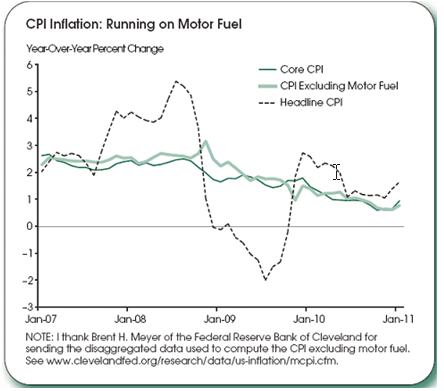
With gas prices high and food prices rising, many people are feeling the squeeze.  This begs the question: Is inflation a concern?  I say no, not yet at least, and the chart from the St. Louis Fed (via the Pragmatic Capitalist) illustrates why:


As the chart shows, essentially all prices outside gasoline are staying relatively flat.  While there has been a modest uptick as of late, as Paul Krugman points out, inflation is still way below trend. 

That isn’t to say inflation won’t eventually be a problem.  In fact, I have seen charts, given the recent move up, that demonstrate there could be higher inflation in the near future.  Still, given the small uptick in inflation, high unemployment, and lack of credit moving through the system, inflation should be relatively tame and I certainly assuage only a very small probability to hyperinflation.